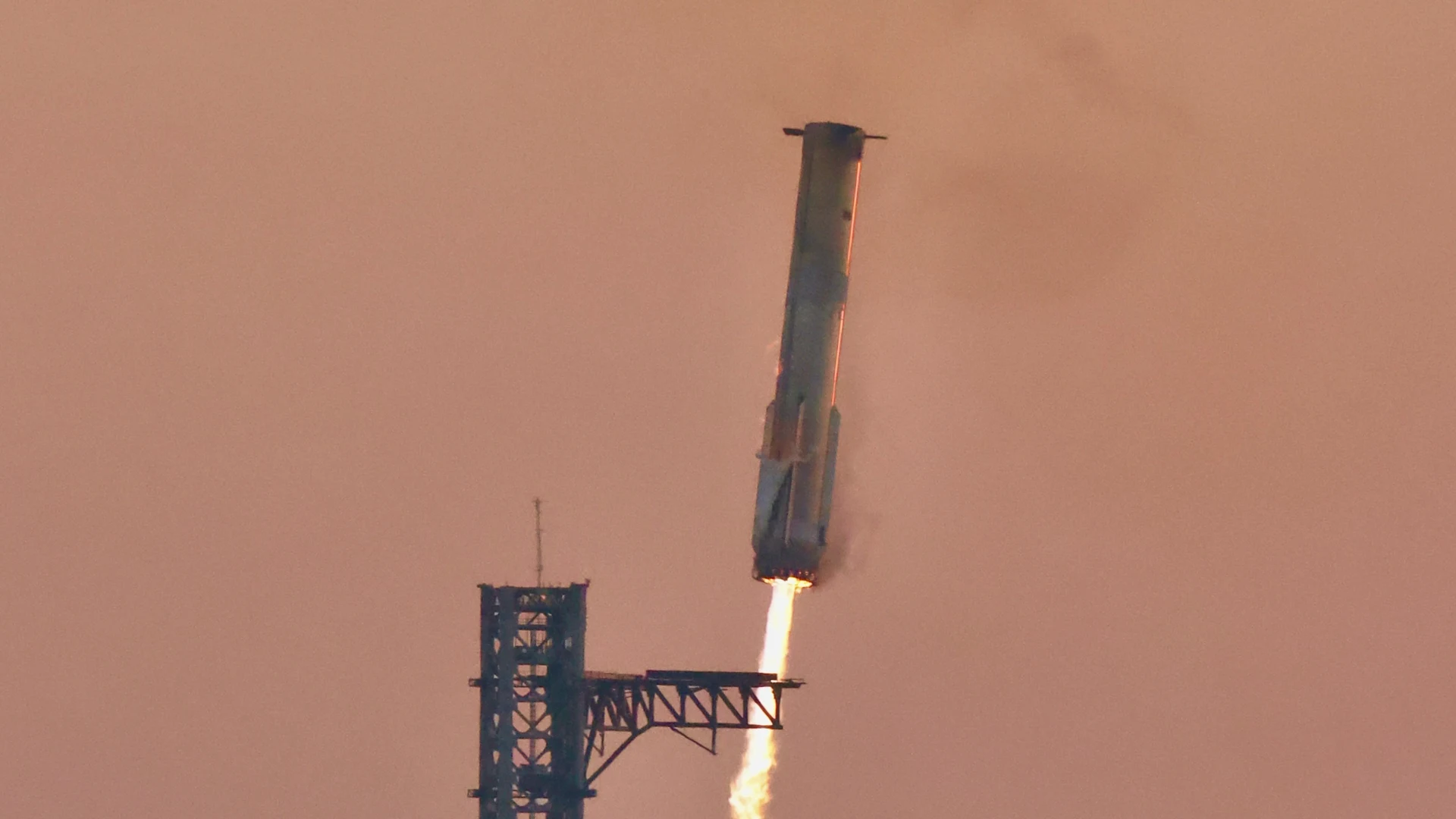
SpaceX Catches a Starship Returning From Orbit for the First Time — but the Booster Is Lost
SpaceX's Starship made a triumphant return to Earth on Saturday, caught in mid-air by giant mechanical arms at the Texas launch tower where its journey had begun 22 hours earlier. It was the first-ever capture of a Starship flying back from space — the grand finale Elon Musk and his team had hoped for — but with the first-stage booster exploding shortly after Friday's liftoff, the company fell short of the double catch it had set out to achieve. The dramatic, science-fiction-like capture helped blot out the booster's messy miss, and SpaceX officials said it demonstrates the full reusability of the largest and most powerful rocket ever built.
The world's largest rocket — a 124-metre behemoth — blasted off late on Friday afternoon from SpaceX's Starbase facility near the US–Mexican border, on its 15th flight of a full-scale Starship since 2023 and only its second trip to orbit. The plan was the most ambitious in the programme's history: catch the Super Heavy booster about six and a half minutes after liftoff, send the Starship into low Earth orbit for more than 22 hours, and then catch the spacecraft itself as it returned to the pad. Shortly after reaching orbit, Starship dropped off 26 of the company's most advanced Starlink satellites, then settled into a cruise some 275 kilometres up, completing 14 laps of the planet with live views of itself and Earth streaming down via Starlink.
The first half of the plan went wrong within minutes. The booster's engines stopped firing too soon on the way back down, its guidance system sensed it was not in the right position, and the catch attempt was aborted. Super Heavy Booster 22 was diverted to a splashdown in the Gulf of Mexico, where it exploded. It was the first attempt to recover the upgraded Version 3 booster, the production model intended for Moon and Mars expeditions, and SpaceX had already made three booster catches with the earlier design. Wreckage remained in the Gulf, cordoned off by buoys, as the spacecraft continued its long orbit overhead.
On Saturday, Starship came home. The spacecraft fired one of its engines to begin its plunge through the atmosphere while flying eastward over the Pacific, re-entered glowing red, flew over Mexico's Baja Peninsula and then over Mexico and Texas, and burst through grey cloud over Starbase. It flipped itself vertical, fired its engines and lowered itself slowly to the launch tower, where two mechanical arms — nicknamed Mechazilla — closed in and grasped it. With its aerodynamic fins folded back, two small fittings near the top of the 52-metre spacecraft hooked onto the arms, leaving it hanging a few hundred feet off the ground. "Ship 42 looks great!" Mr Musk posted, sharing photographs taken from the tower.
The catch matters because it is the step SpaceX needs to make Starship fully and rapidly reusable. The company wants to launch potentially thousands of satellites for its Starlink internet constellation, and Starship is intended as the workhorse for that business, as well as for returning humans to the Moon and, eventually, settling on Mars. Until now, no orbital launch system has ever been recovered whole; SpaceX has yet to bring back both stages of a single mission, which would mark the first-ever return of an entire orbital system. The company expects to begin launching Starships from Florida's Kennedy Space Center within the next few months, and from Louisiana in a few years.
Online, the engineering crowd was already looking past the celebration. On Hacker News, where the catch drew nearly 1,000 points and more than 660 comments, the most-read reaction called Starship "essentially, Space Shuttle done right" — fully reusable, without solid boosters — and said the next step is the double catch and re-flying the same ships, which would make payloads to orbit significantly cheaper. What happens next is a second attempt at the double catch. The booster failure will be investigated — engineers will want to know why the engines cut out early — but the ship's return, after 14 orbits and a day in space, is the milestone the programme has been chasing since the first Starship flights three years ago. For a vehicle designed to fly again and again, the sight of a spacecraft that has circled the Earth being gently plucked from the sky by the tower that launched it is the proof of concept made visible. The question now is how quickly SpaceX can do it twice in one flight.
- NPR Illinois — SpaceX successfully catches Starship and makes history
- Associated Press via Phys.org — SpaceX's Starship soars into orbit after booster explosion prevents an unprecedented double catch
- AAP — SpaceX Starship returns to landing pad from orbit
- NPR via WETS — SpaceX makes history with Starship catch
- Cover photo: A Starship booster being caught by the Mechazilla arms during Flight 5 in October 2024 — Photo: Steve Jurvetson / Wikimedia Commons (CC BY 2.0)