The AI Boom's Dirty Secret: Data Centres Set to Drive Emissions 70% Higher by 2030
The world's data centres will create 70% more carbon emissions within the next four years as the United States and China turn to fossil fuels to power their artificial intelligence growth, the International Energy Agency has warned in its influential annual World Energy Outlook, published on Thursday. The Paris-based agency said data centres would consume twice as much electricity by 2030 as they do today, with the global expansion of artificial intelligence accounting for three-quarters of that growth — and within four years, AI data centres alone will need an extra 350 terawatt-hours of electricity every year, more than the entire annual power consumption of Great Britain.
The regional split is where the story grows uncomfortable. By the end of the decade, around half of the electricity needed to power China's AI data centres will come from coal power plants, according to the IEA, with the rest coming from renewable energy and smaller amounts from nuclear reactors and very little from gas. In contrast, the United States is expected to rely on gas to provide about 60% of the electricity for its data centres by 2030. There were plans for about 180 gigawatts of new gas-fired power plants linked to American data centres in August this year, the agency said — almost as much new gas capacity as the total now installed across the entire European Union. The appetite for gas power among American data centre developers is more than sixteen times higher than in Canada, where the IEA identified plans for 11 gigawatts of gas generation to power servers; in the rest of the world, AI developers have put forward plans for new gas plants with a combined capacity of just 4 gigawatts.
The scale of the buildout is staggering. Investors will pour some $4 trillion into data centres globally by 2030, following $565 billion of investment in 2025, the IEA wrote, with around three-quarters of the anticipated growth in centres dedicated to the training and use of artificial intelligence rather than traditional purposes such as cloud storage or video streaming. To track the notoriously opaque industry, the agency has begun using satellite imagery to monitor the construction of 93 large "AI factories" around the world. Its analysis suggests the world's data centre capacity has climbed tenfold in the last twenty-four months to 17 gigawatts, and that by the time the AI factories now being built are completed, their combined capacity is likely to be about 50 gigawatts — roughly as much as the peak electricity demand of Great Britain. The world's existing stock of data centres now stands at 120 gigawatts, with 80% of that capacity in China, the United States and the European Union, and a further 120 gigawatts will be built by the end of the decade, of which three-quarters will be AI data centres.
The surge is already testing power grids and public patience. In some major growth markets, planned data centre developments would exceed current peak power demand if they all came to fruition, the IEA warned, and the technology's rapid adoption by some of the world's largest companies has fuelled a backlash in communities where residents worry the boom is pushing up electricity costs. Data centre developers have emerged as the world's biggest corporate buyers of renewable energy, yet the report showed that the appetite for fossil fuels is expected to grow even faster, particularly in the United States and China. The agency based its forecasts on data showing the annual global shipment of AI servers has climbed eighteen-fold since 2020. A separate Harvard-led study published this week in Nature Sustainability underlines the scale of the problem at home: America's 403 largest hyperscale data centres generated approximately 25.7 million metric tons of carbon dioxide between May 2024 and April 2025, roughly as much as the entire nation of Denmark.
The IEA placed the data centre surge inside a wider energy picture that has grown darker. Its annual report warned that the world's energy future was less certain after the impact of the Middle East war, which it has described as the greatest energy market disruption in history, and its executive director, Fatih Birol, was blunt about what comes next. "I don't see any credible pathway for the energy world to return to the way it was before," he said. Instead, the agency said, the energy system will be reshaped by the policy decisions governments make after the crisis — to meet rising demand from a growing global population, the growing need for air-conditioning, and a booming AI economy. The European Union stands out as the exception to the fossil-fuel drift: the IEA expects its data centres to rely on renewables for about 70% of their electricity by 2030, followed by nuclear power, gas generation and a very small amount of coal.
What happens next will be decided less by the technology companies than by the governments that approve their power supplies. If new data centre demand is met mainly with gas and coal, as the IEA's central scenario expects in the world's two largest markets, the AI boom will lock in a large new source of emissions just as countries are meant to be cutting them. If governments instead steer the buildout towards clean power — as the European Union's mix suggests is possible — the same boom could be powered without the carbon penalty. The constraint is not only climate: grids, equipment supply chains and public acceptance are all under strain, and the IEA's warning is, in the end, a warning about choices. The AI factories are being built now; the power plants that will run them are being planned now; and the emissions they produce in 2030 will be decided by the permits issued in the next few years.
- The Guardian via EuropeSays — Datacentres to create 70% more carbon emissions by 2030, IEA report warns
- Bloomberg via Energy Connects — IEA Sees Data Center Boom Pushing Power Grids to the Limit
- Startup Fortune — IEA warns data centre emissions will jump 70% by 2030 as AI demand grows
- World Brief — IEA sees data-centre electricity demand doubling by 2030
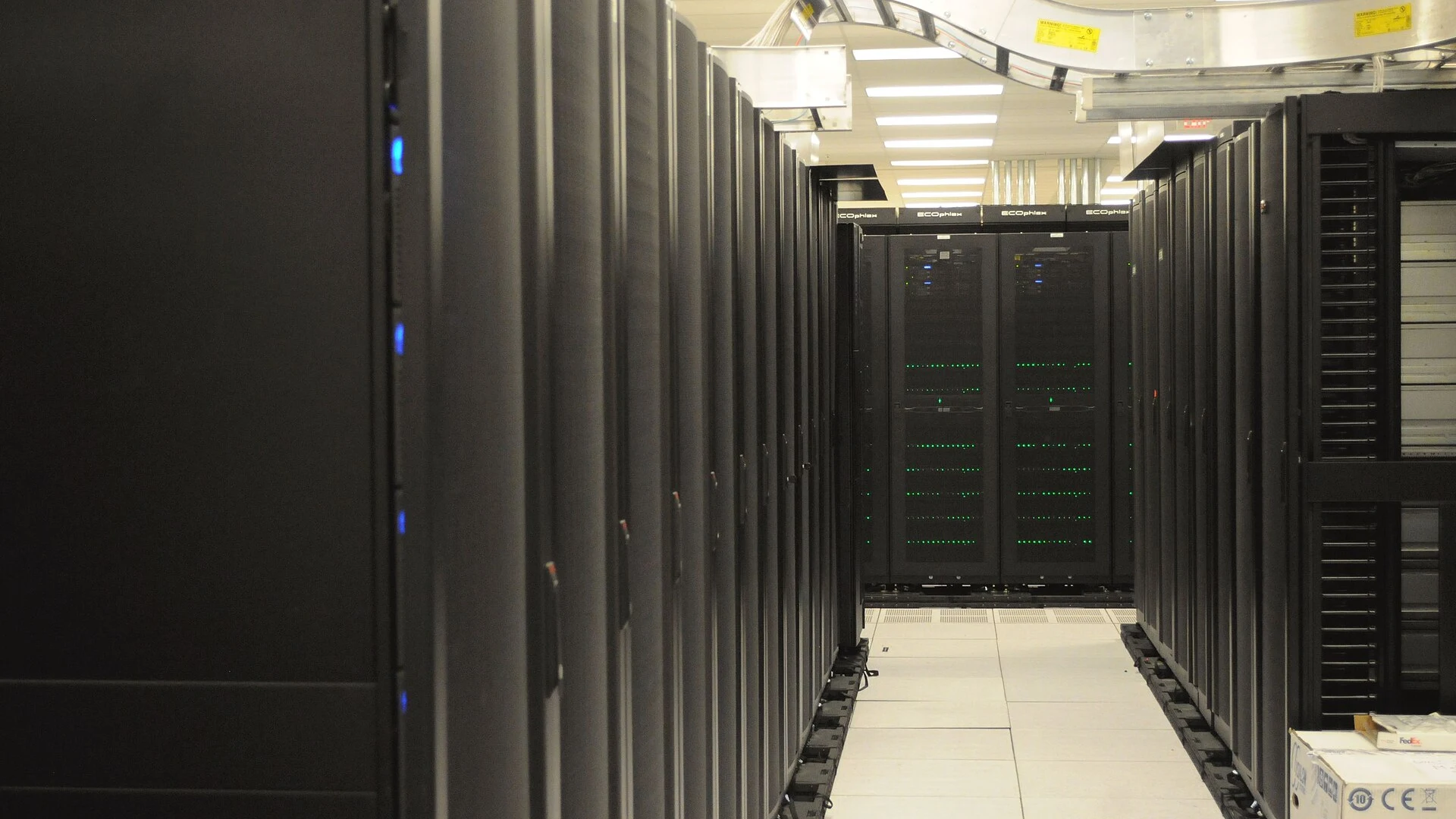
- Cover photo: Front of server racks at NERSC (National Energy Research Scientific Computing Center), photographed 14 October 2011 — this is not a photo of an AI data centre; it shows a server hall of the kind the IEA report covers — Photo: NERSC / Wikimedia Commons (CC0 1.0)