Nvidia's Founder Is Gone: Jensen Huang Resigns as a Third Alleged Affair Emerges Hours Later
Nvidia announced on Thursday that Jensen Huang, the co-founder who built the company into the engine of the artificial intelligence boom, has resigned as president, chief executive and director, effective immediately. The board accepted his resignation on Wednesday, after directors met for several hours to decide his future, and named chief financial officer Colette Kress, 59, as interim chief executive. Kress will keep her roles as executive vice-president and chief financial officer while the board searches for a permanent successor. The board also appointed Harvey C. Jones, a director since 1993, as its first-ever chair. The company's announcement gave no reason for Huang's departure and contained no quote from him, ending a 33-year tenure at the company he founded in 1993.
The resignation came at the end of a two-week crisis that began with a national security allegation. On 29 October, the New York Times reported that Huang had a close relationship with Alice Huang, an executive at Megaspeed, a Singapore-based Nvidia customer, whom US officials had concluded in a classified May memo was a Chinese intelligence asset. The Financial Times later reported that a US government memo said the two had been romantically involved, an account China has denied and Huang has rejected in relation to espionage. On Sunday, Huang acknowledged in a letter to staff that he had been unfaithful to his wife, apologising without naming the person involved, and the board opened an independent investigation. Then on Wednesday, the Times reported, citing five people who worked at the company, that Huang had also had a relationship with Kimberly Powell, Nvidia's vice-president of healthcare, who reports to him.
Hours after the resignation was announced, the scandal widened again. Reuters reported, citing two people familiar with the matter, that Huang had an intimate relationship with a second, unnamed Nvidia employee, bringing the number of alleged extramarital relationships to three. Reuters did not identify the woman and said its attempts to reach her were unsuccessful; Nvidia declined to comment. On Thursday, US Attorney General Todd Blanche said at a press conference that the Justice Department had not determined whether Alice Huang was a Chinese spy. No finding of espionage or wrongdoing beyond the admitted infidelity has been published, and the board's independent investigation, led by former acting US attorney Joon Kim and the law firm Wachtell, Lipton, Rosen & Katz, is still under way.
The market has already delivered its verdict on the uncertainty. Nvidia shares fell about 8 per cent in after-hours trading on Wednesday after the Wall Street Journal reported that directors were preparing to oust Huang, then briefly dropped 14 per cent in early trading on Thursday, pulling all three major Wall Street indices down by about 0.4 per cent. The slide has erased roughly $600 billion of market value this week, after the stock lost about $430 billion across Monday and Tuesday. Analysts at Baird said Huang might have to step down and downgraded the stock, while Dan Ives of Yorkville Ives estimated the company could lose $1 trillion of market value if Huang were pushed out, a measure of how personally investors identify the chipmaker with its founder, who owns about 3.6 per cent of the company. A shareholder class action filed on Monday in a California federal court added a legal front, alleging that Nvidia and Huang misled investors in their responses to media reports about the affair.
Kress now faces the most consequential first week of any interim chief executive in the industry's history. Nvidia will report third-quarter fiscal 2027 results as scheduled on Tuesday, 17 November, with an earnings call that afternoon, and Kress is due to address employees at a company meeting the following day. The board said it would consider internal and external candidates for the permanent job and gave no timeline. Megaspeed, the Singapore customer at the centre of the affair, is separately under federal investigation over allegations that it diverted highly sought-after US semiconductors to entities in China in violation of export controls, and the Journal reported that the Justice Department is now leading multiple investigations involving Alice Huang, with a congressional subpoena also a possibility.
Online, the reaction has been a mix of disbelief, gallows humour and genuine unease about what a leadership change means for the AI boom. The announcement thread on r/nvidia drew more than 4,100 upvotes and 1,500 comments, while a thread on r/technology about the third alleged affair passed 23,000 upvotes. On Hacker News, one widely discussed comment argued the affairs were not the real reason for his departure, pointing to reports that Nvidia had been skirting US export controls. What happens next turns on the board's inquiry and on the earnings call: whether Huang was targeted, whether any company or national security information was compromised, and whether the company whose chips power the global AI build-out can separate itself from the one man who has led it since the beginning.
- TechCrunch — Nvidia's Jensen Huang resigns, chipmaker names CFO Colette Kress as interim CEO
- Associated Press — Jensen Huang resigns as Nvidia CEO
- The Wall Street Journal — Nvidia is preparing to oust Jensen Huang
- TradingView — Former Nvidia CEO Huang had third alleged affair, Reuters reports
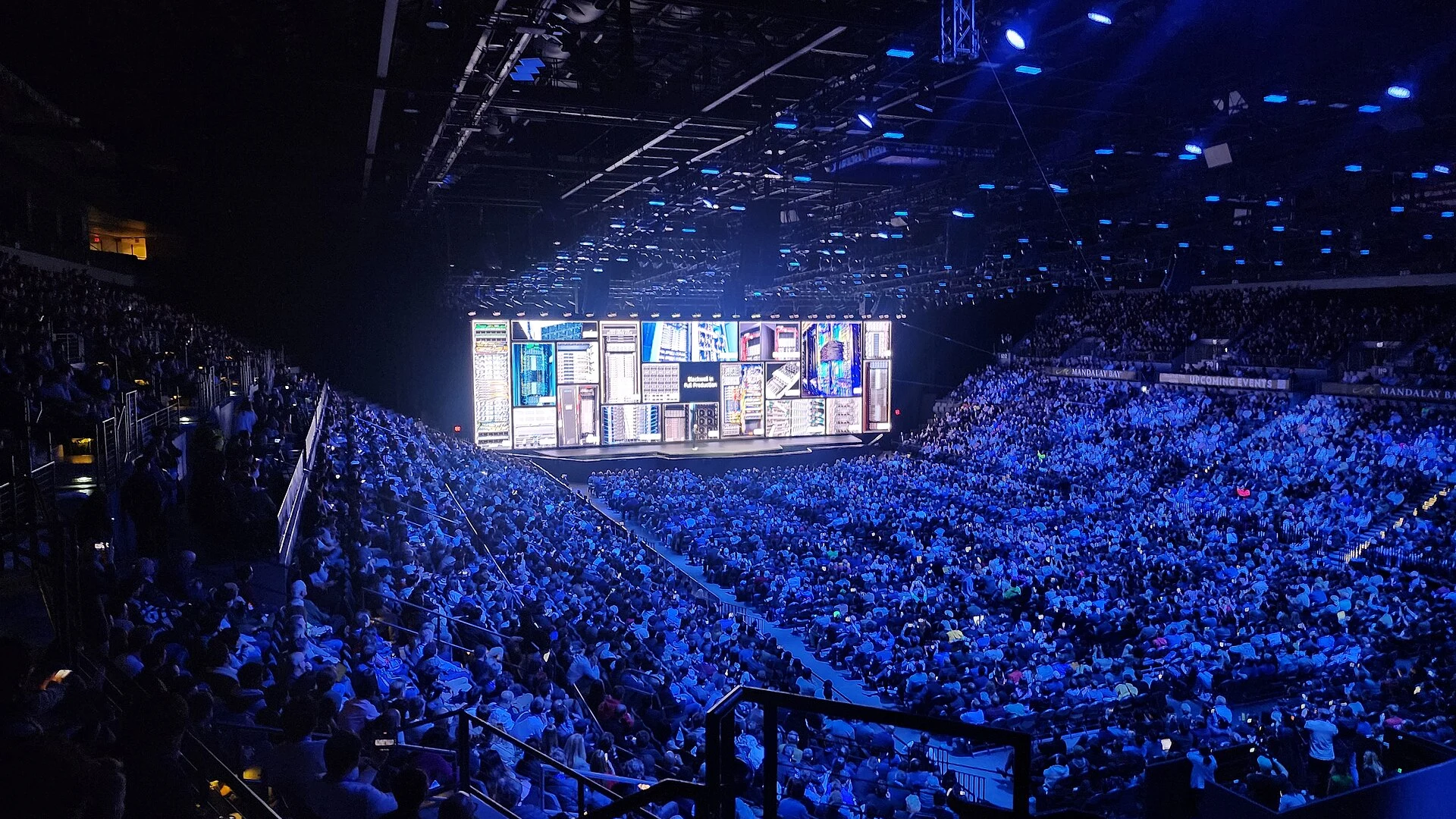
- Cover photo: Jensen Huang delivers the keynote at CES 2025 in Las Vegas — Photo: Joseph Zadeh / Wikimedia Commons (CC BY-SA 4.0)