Putin Lets Europe Into the Ukraine Talks, but Moscow's Own Aides Say the Door Is Barely Open
President Vladimir Putin agreed on Thursday to let European representatives join the next round of Ukraine peace talks, a US envoy said, in what could mark a breakthrough in a diplomatic process that has kept Europe on the sidelines for nine months. Steve Witkoff, who spent about two hours with Putin in the Kremlin alongside fellow envoy Jared Kushner, told Russian state television afterwards: "The Europeans will join at the next meeting, which we consider to be a very important moment because they are our partners and it's important to us that they take part." Kushner said Putin was "willing to give it a try" and added: "We cannot conclude this deal without the Europeans being at the table." The two envoys then flew to Ireland and met President Volodymyr Zelenskyy, who said he was pleased at the prospect of further rounds of talks and European participation in them. Witkoff said the next meeting was "on the schedule", though he gave no date or place.
Moscow's own account of the same meeting told a different story. In a briefing after the talks, Kremlin aide Yuri Ushakov did not confirm that the Europeans would join the next round, saying instead that they "must decide whether they want peace or the continuation of the war". Russia has played down the prospect of Europeans at the table and has asked Europe to cease military aid to Ukraine as a condition. During the Kremlin talks, Kushner told Putin that Washington had detected what he called "a big change" on the European side and was confident that expanding the talks to include the Europeans would not hinder progress. The gap between Washington's announcement and Moscow's readout is now the central question of the diplomacy: whether Putin agreed to a European seat, or merely agreed to discuss one.
The envoys did bring one concrete result out of the week. The two days of US-mediated talks between Russia and Ukraine in Abu Dhabi ended on Wednesday with agreement in principle on a large-scale prisoner exchange that Kushner described as the "biggest humanitarian release of prisoners" of the conflict. Zelenskyy said on Thursday that it would be the biggest exchange of the war yet, telling reporters at Casement Aerodrome in Dublin: "It will be the biggest, Steve and Jared told me, the biggest exchange of war prisoners yet." He had earlier said negotiators discussed exchanging 1,000 prisoners from each side, or possibly 1,200 to 1,500, though Ushakov said the parameters of the exchange were still being agreed. Kushner said Washington was working towards an exchange that could "potentially reunite thousands of people with their families".
The diplomacy is unfolding against fighting that has not paused for it. Russia's military said it had carried out a massive overnight strike on military factories across Ukraine, including Kyiv, where the mayor said a Russian drone had struck an apartment block. Ukraine answered with a mass drone attack on Moscow that grounded flights at major airports. Zelenskyy also said new restrictions were affecting the US-made satellite communications Kyiv uses on the battlefield, and that he found the US approach of discussing a new European security order with Russia "a bit strange". On r/ukraine, a thread asking why Starlink and Starshield access keeps being limited mid-war drew hundreds of upvotes, a sign of how closely Ukrainians are watching the systems their defence depends on.
Who would actually speak for Europe remains undecided, and the Europeans themselves disagree. The EU's foreign policy chief, Kaja Kallas, said the treaties give the seat to the European Council president, António Costa, and herself; the German chancellor, Friedrich Merz, named the E3 group of Britain, France and Germany plus a group of five; the French president, Emmanuel Macron, said the format "will be determined" later. EU leaders are set to discuss on Friday the possibility of appointing a special envoy for the diplomatic process. Putin, meanwhile, warned that foreign troops fighting in Ukraine are "legitimate targets", and said the presence of foreign troops in Ukraine poses a threat to Russia's national security. Territory remains the obstacle neither side will move on: Moscow demands Ukraine give up the parts of the eastern Donbas it still holds, while Kyiv wants to freeze the fighting along the current contact line, and Russia's chief negotiator, Vladimir Medinsky, has declared there is "no possibility" of territorial exchanges.
What happens next will show whether Europe's seat is real or rhetorical. Ushakov said Moscow would speak to Witkoff and Kushner again before the meeting of Putin and Trump in China, at the APEC summit in Shenzhen, and the date and place of the next round of talks are the first marker to watch. The envoys' shuttle — Moscow in the afternoon, Dublin in the evening — has at least kept the process moving where nine months of trilateral talks produced almost nothing, and the prisoner exchange, if it happens at the scale Zelenskyy described, will be real for thousands of families. For the war itself, the test is the same as it was in Abu Dhabi: whether a wider table can do what a narrow one could not, and close the gap on the land, the ceasefire and the security order that would have to follow.
- Reuters via 985 The River — Putin lets Europe join Ukraine peace talks, Zelenskiy welcomes prospect
- Reuters via SRN News — Putin lets Europe join Ukraine peace talks, as Kyiv says Starshield disrupted again
- Silent Dossier — Ukraine peace talks: will Europe join the next round?
- Euronews — Russia plays down peace talks with Europe after Witkoff raises hopes of breakthrough
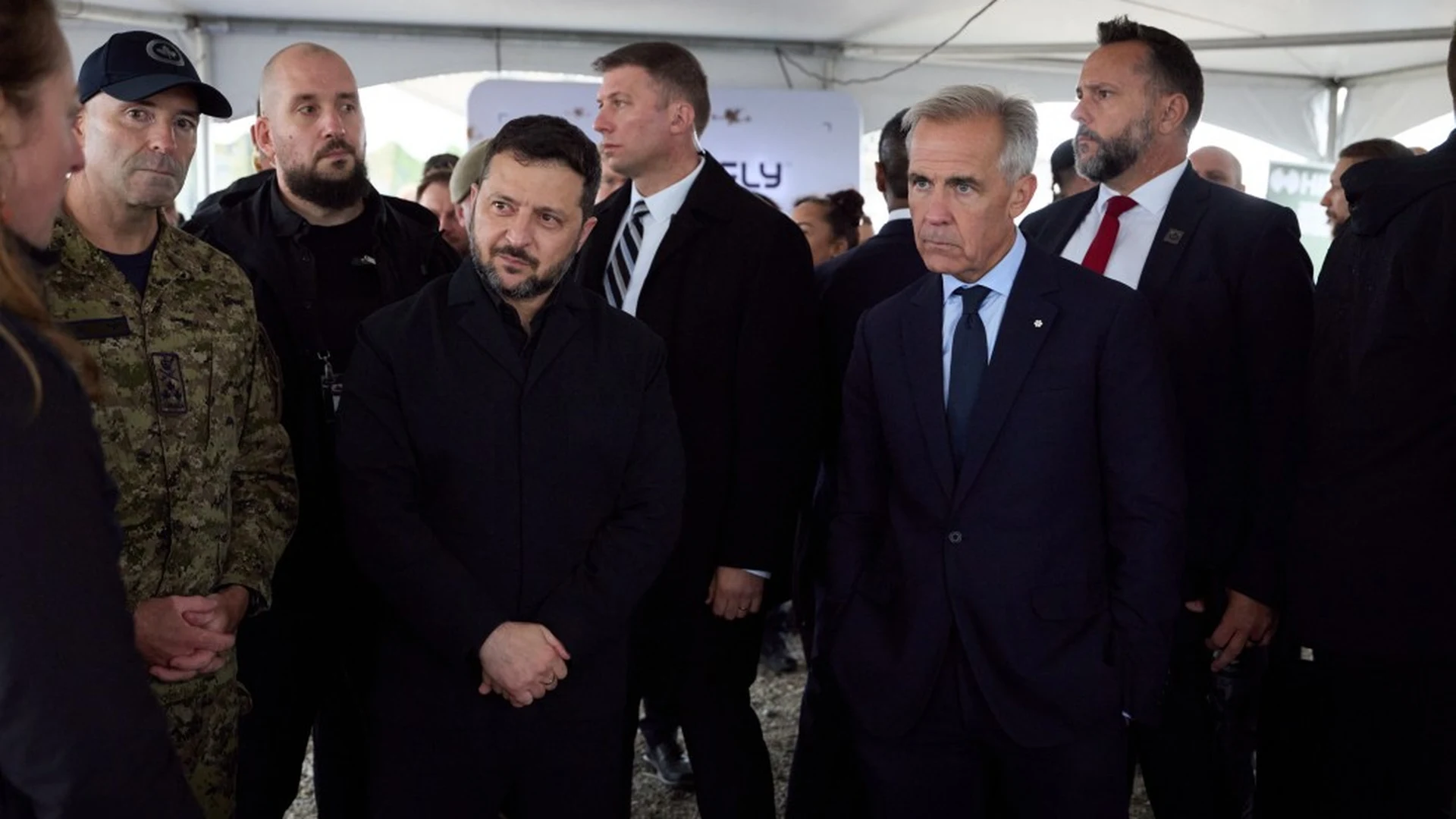
- Cover photo: Volodymyr Zelenskyy visits Canada, September 2026 — Photo: Vinnytsia Oblast State Administration / Wikimedia Commons (CC BY 4.0)